
Speech & language APIs
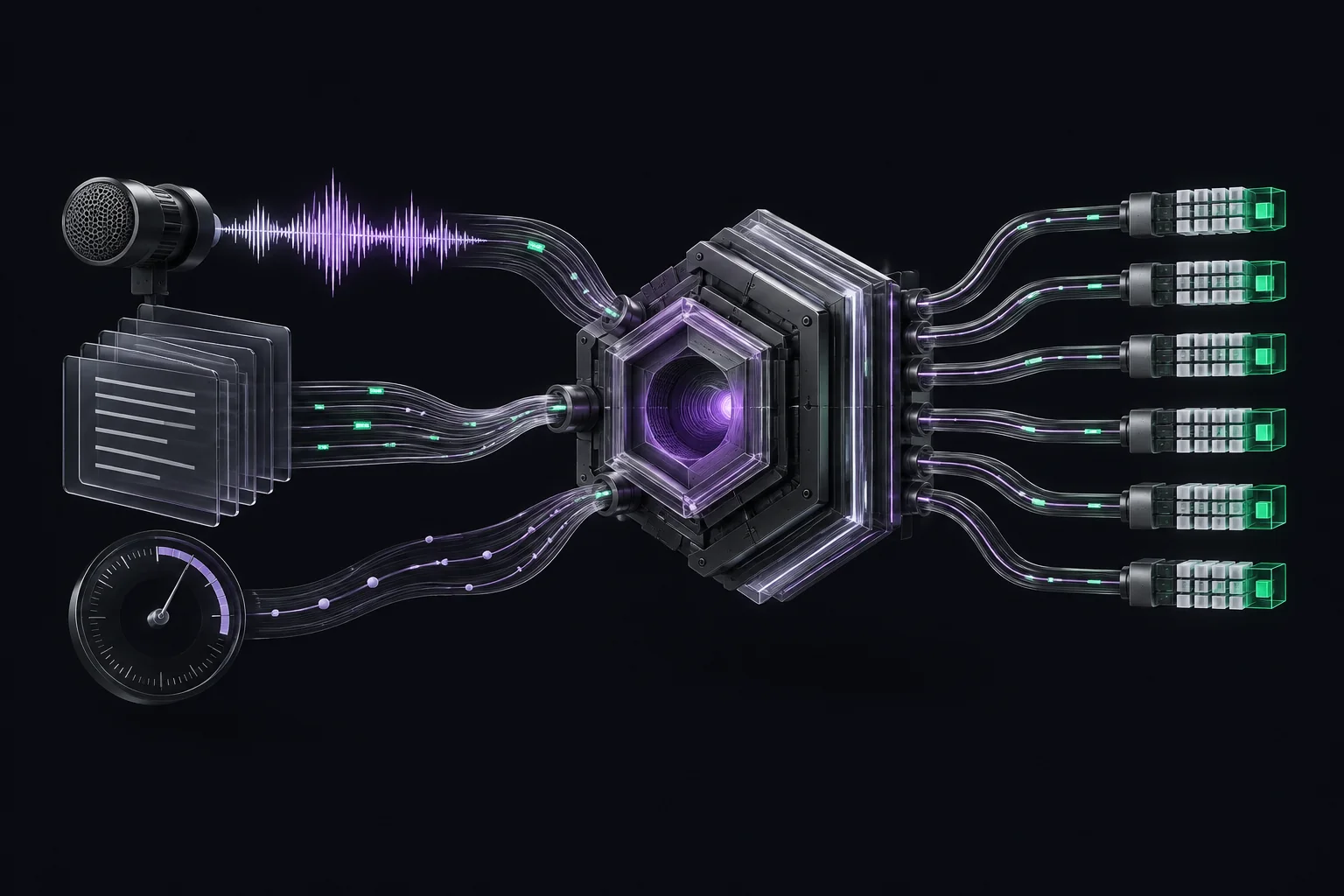
A plug-and-play toolbox of speech recognition and natural-language models, kept at the state of the art and served as REST endpoints. No GPUs to run, no models to train, no ML team to hire.
01 / one request
Call an endpoint.
Get structured text back.
Every service is a plain REST endpoint behind one account. Point your existing HTTP client at it and the model is somebody else's problem — ours.
$ curl -X POST <base-url>/nlp/sentiment \
  -H "Authorization: Bearer $PROSOFT_KEY" \
  -d '{"text":"Resolved in two minutes, thank you"}'
{
  "label": "positive",
  "score": 0.97,
  "latency_ms": 41,
  "status": "ok"
}
Illustrative request and response shape. Exact paths and parameters come with your key.
What goes in. What comes out.
Audio, text or a plain phrase on one side; a transcript, a sentiment, a time range on the other. These are illustrations of the shape, not live calls.
I was charged twice on the thirteenth
Resolved in two minutes, thank you — I nearly gave up on the first line.
“the morning after Labor Day”
Labor Day is Mon 7 Sep 2026, so the morning after is Tue 8 September 2026, 06:00–12:00 America/New_York
Six services. One account.
Speech in, structured text out. Each service is its own REST endpoint; register once, call the ones you need, and we keep the models behind them at the state of the art.

v4.19.2
# Move over any service to see the shape of
# its request and response. Each one is a
# plain REST call with your key.
median time from
arXiv preprint to
live endpoint
Why daily.
Benchmarks move every week. If your speech recognizer is six months old, it's already behind. When a paper hits preprint and we can build an image from the code, it runs against our evaluation set the same day and the winner is promoted automatically. Your endpoint path doesn't change. Your results do.
 new / NarWal
Point at it. Say it.
Hand it to your agent.
NarWal is a browser extension that records one tab, your voice and what you point at, then writes it out as text an AI agent or a colleague can read. No video to watch. Nothing leaves your browser unless you choose.
05 / start